
When QuantLase Research and Development Center introduced the Photonic Intelligence Processing Unit (PIPU™) in its first whitepaper, the work began with a fundamental scientific question:
Can the physical dynamics of light be harnessed as a computational resource for complex, time-varying information? The first whitepaper introduced the PIPU concept and its experimental foundation. Rather than treating photonics simply as a faster means of moving data, PIPU explores how physical optical dynamics themselves can participate in computation.
At the heart of the experimental platform is a closed-loop photonic architecture in which coherent light, spatial modulation, optical propagation, detection and feedback interact within a controlled dynamical regime. Particular attention was given to operation around the edge of chaos, where nonlinear dynamics can exhibit a balance between stability and sensitivity. That work established the scientific foundation. The next challenge was more demanding, testing the concept against a real-life use case.
Moving Beyond the Concept
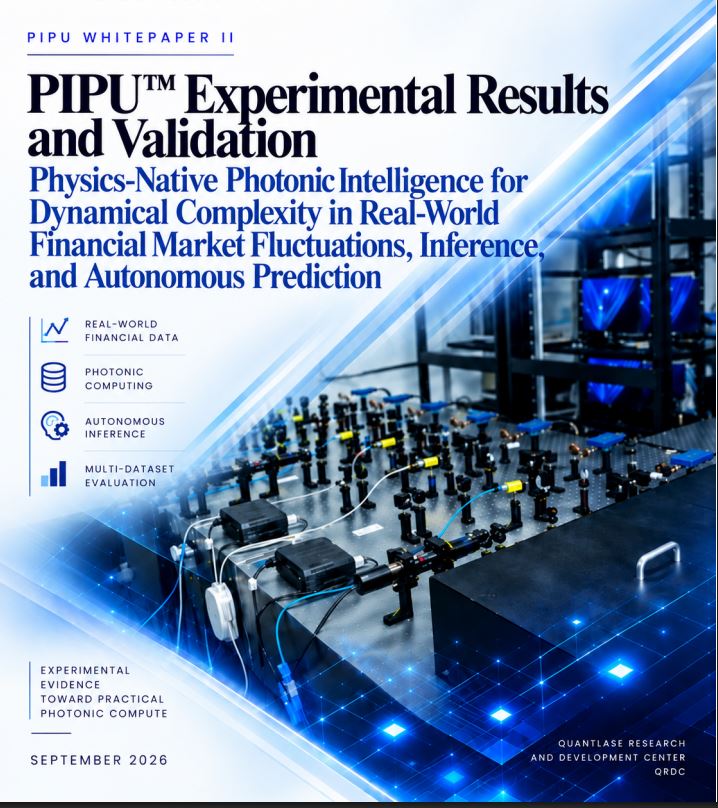
The second PIPU whitepaper, PIPU™ Experimental Results and Validation: Physics-Native Photonic Intelligence for Dynamical Complexity in Real-World Financial Market Fluctuations, Inference, and Autonomous Prediction, represents this next stage.
Rather than introducing another theoretical architecture, the study applies the physical PIPU platform to real-world financial market data, selected as a demanding example of nonlinear, fluctuating and time-dependent information.
Seven datasets spanning different companies and sectors were evaluated, including Apple, Amazon, NVIDIA, JPMorgan Chase, First Abu Dhabi Bank, ADNOC and Reliance Industries.
The purpose was not to develop an investment or trading system. Financial market data instead provided a practical real-life test environment containing changing trends, fluctuations and complex temporal behaviour against which the experimental computing platform could be examined. This distinction is important. Whitepaper I asked whether the underlying photonic approach could form a computational platform. Whitepaper II asks how that platform behaves when confronted with complex real-world data.
Scientific Validation Through a Real-Life Use Case
The new study moves the PIPU programme from conceptual demonstration toward experimentally grounded validation. For each dataset, the physical PIPU system was operated within the same broad experimental edge-of-chaos parameter window, while dataset-specific configurations were retained for subsequent inference. The experiments examine two particularly important stages.
First, PIPU is evaluated against observed financial data to determine how the physical system represents and follows temporal behaviour within the measured window. Second, the platform transitions into autonomous prediction, where it continues generating its own trajectory beyond the observed-data boundary without additional training during that prediction interval.
The results are also considered alongside two computational references: an AI time-series comparator operating in its defined short-horizon testing regime, and a GPU implementation that numerically simulates the PIPU dynamical equations. This comparison is deliberately important. The GPU model represents a digital numerical counterpart of PIPU, whereas PIPU + GPU incorporates the physical photonic experiment, with the GPU providing the electronic interface, data handling and control around the optical system. The objective is therefore not simply to produce another prediction curve. It is to investigate whether the behaviour first explored scientifically in PIPU can be translated into measurable computational behaviour on real-world data.
From Visual Results to Quantitative Evidence
Scientific validation also requires moving beyond visual agreement. For this reason, the second whitepaper introduces quantitative analysis of the observed experimental windows, including measures such as mean behaviour, standard deviation, fluctuation range, relative range, mean absolute error (MAE) and root mean square error (RMSE) where applicable. The supporting datasets are also being made available through Zenodo, allowing the experimental evidence accompanying the whitepaper to be examined beyond the figures presented in the publication.
This represents an important progression for PIPU:
Concept → Physical Experiment → Real-World Use Case → Quantitative Validation
Each stage asks a harder question than the one before it.
Photonics and Digital Computing Working Together
Another lesson emerging from the programme is that the future of photonic computing does not necessarily require choosing between photonics and GPUs. The experimental PIPU workflow is inherently hybrid. Physical optical dynamics provide the photonic transformation, while conventional digital infrastructure supports data handling, electronic control and system interfacing.
This complementary architecture points toward a broader possibility: photonic computing functioning as a specialized computational resource within the existing digital ecosystem rather than attempting to replace that ecosystem wholesale. That principle also underpins the longer-term PIPU service model being explored by QRDC, where a user could eventually interact with a managed computing service while the physical photonic processing remains behind a secure digital and cloud interface.
What Comes Next
The second whitepaper is an important milestone, but it is not the end of the validation process. Broader datasets, repeated experiments, longer evaluation horizons, system-level engineering and further quantitative characterization will all be important as the platform matures.
The pathway is therefore intentionally progressive:
Scientific concept → experimental platform → real-life validation → platform readiness → controlled access → broader deployment.
External access will follow technical readiness, appropriate governance and the formal deployment pathway established by QRDC and IHC. What has changed between the two whitepapers is significant. PIPU began as an investigation into whether complex physical dynamics of light could provide a useful computational framework. The latest work puts that proposition against real-world data, measurable outcomes and a practical use case.
The full whitepaper is now available at https://quantlase.com/lab/advanced-computational-lab#